Your Hands Know Before You Do: The Embodied Science of Artisan Baking
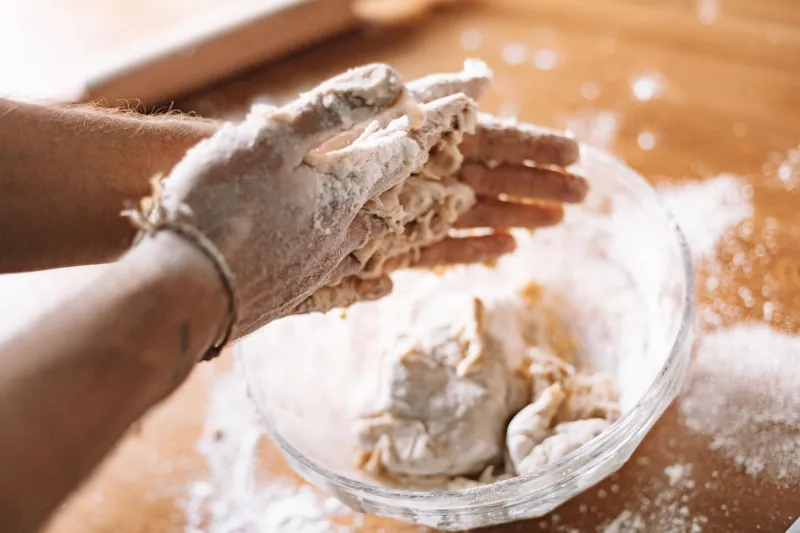
Ask a baker how they know the dough is ready and most of them will pause before answering. Not because they don't know — but because the knowledge lives somewhere that's hard to put into words. "It just feels right" is the most common answer, and it sounds like a dodge until you understand what's actually happening in those hands.
At Merritt Bakery, the bakers start their shifts in the dark. By the time most of Oakland is reaching for its phone, these folks have already had their hands in dough for two hours. They've assessed fermentation by touch, adjusted hydration by feel, and made a dozen small decisions that never appear in any recipe. The loaves that come out of this kitchen every morning are the product of those decisions — and of something that neuroscientists call embodied cognition.
In plain language: your body learns things your brain doesn't consciously register. And in baking, that kind of knowledge is everything.
What Repetition Actually Does to a Baker
When you perform a physical task thousands of times, something structural changes in your nervous system. The neural pathways associated with that movement become faster and more efficient — a process called myelination. The conscious deliberation that marked your first attempts gets compressed into something closer to reflex. You stop thinking about what you're doing and start just doing it.
For a baker, this shows up in remarkably specific ways. A baker who has shaped a few hundred boules will notice, without being able to articulate why, that today's dough is slightly tighter than yesterday's. They'll adjust the pressure of their hands, give the dough a few more minutes of rest, or add a small amount of water to the next batch. None of this comes from the recipe. All of it comes from the accumulated physical memory of every loaf that came before.
"There's a moment in shaping where the dough kind of talks back to you," one of Merritt's morning bakers explained during a recent early shift. "It has tension, but not too much. It moves with you but doesn't fall apart. When that's happening, you know. When it's not, you feel that too — usually before you can explain what's wrong."
Touch as Data
The human hand contains roughly 17,000 touch receptors. It's one of the most sensitive instruments in the biological world, capable of detecting differences in texture, temperature, elasticity, and resistance that no commercial sensor can match at the same cost or speed.
For artisan bakers, this sensitivity is the primary diagnostic tool. A dough that's properly fermented has a different feel than one that's underproofed — it has a lightness, an almost pillowy quality, that comes from the carbon dioxide produced by active yeast. Overproofed dough, by contrast, feels slack and fragile, like it's lost structural integrity. The difference between these states might be 20 minutes of fermentation time. The difference in the final loaf is significant.
Timers help. Thermometers help. But they're lagging indicators — they tell you what happened, not what's about to happen. An experienced baker's hands are leading indicators. They catch the problem before it becomes the problem.
This is why the bakers at Merritt check their dough constantly, pressing, folding, lifting, stretching. It looks casual. It's anything but.
Why Recipes Are the Beginning, Not the End
New bakers often make the mistake of treating a recipe like a guarantee. Follow the steps, get the result. And for a while, in a controlled environment with consistent ingredients and predictable conditions, that works well enough.
Then you bake on a humid August morning and everything changes.
Flour absorbs water differently depending on the ambient humidity. Fermentation speeds up in warm kitchens and slows down in cold ones. The same starter that was active and bubbly last Tuesday might be sluggish today for reasons that have everything to do with what it was fed and nothing to do with anything you did wrong. A recipe can't account for all of this. Only a baker who's felt these variables — who has learned through failure and correction and thousands of repetitions — can navigate them in real time.
"The recipe gets you to the starting line," said one of Merritt's more experienced bakers, who has been working with sourdough for nearly a decade. "Everything after that is conversation."
That word — conversation — comes up often in discussions of craft baking. It implies a responsiveness, an attentiveness, that can't be scripted. You bring your knowledge, the dough brings its current state, and together you figure out what the loaf is going to be today.
Why Automation Hasn't Won
The food industry has been trying to automate bread production for over a century. Industrial baking has come a long way — high-output lines can produce thousands of identical loaves per hour, with tightly controlled fermentation environments, robotic shaping, and computerized ovens.
And yet: the bread that comes out of those facilities tastes like what it is. Efficient. Consistent. Correct. But not alive.
The thing that automation can't replicate isn't technique — it's judgment. The micro-decisions that happen when a baker's hands are in dough don't follow a decision tree. They're not algorithmic. They emerge from a form of knowing that is fundamentally physical, contextual, and accumulated over time. You can program a machine to apply a certain pressure to a dough ball. You can't program it to notice that the dough needs something different today.
This is the irreducible core of artisan baking, and it's why places like Merritt Bakery exist — why they fill up and why the bread is worth lining up for.
What This Means for Learning to Bake
If you've been trying to improve your home baking and feel like the recipes aren't getting you there, this might be why. The knowledge you're missing isn't in the instructions. It's in the repetition.
The bakers at Merritt didn't arrive knowing what good dough feels like. They learned it the same way you will — by making a lot of loaves, paying attention, failing in interesting ways, and gradually developing the physical vocabulary to understand what their hands are telling them.
Patience isn't just a virtue in bread baking. It's the mechanism. You can't shortcut your way to muscle memory. You can only earn it, batch by batch, morning by morning, in the dark before the city wakes up.
The loaves that come out of this bakery every day carry all of that history in them. That's what you're tasting when you tear into one. Not just flour and water and salt — but years of hands learning how to listen.